Measuring Product Development.
5minute Read, Product Development ROI. Finally!
Every week in the Day to Day AI newsletter, I break down one client challenge to demonstrate how AI can cut effort from weeks to minutes.
Client Challenge: Measuring Product Development Performance.
Heading into the end of 2025, CFOs are under clear pressure to justify their spending on product development. Market expectations are evolving fast. Most can’t clearly show ROI, Value delivery or competitive positioning.
Without clear value delivery and alignment to market technology standards, product spend turns into a cost centre, not an investment. Funding is impacted, and competitive advantage is stalled.
What I show today won’t measure ROI. AI absolutely can but we are focusing on 20 minute implementations right now. This knowledge share will reduce external costs by enabling standard templates and data structuring for visibility and alignment of stakeholders quickly.
Todays focus: How AI can be used to spin up templates and frameworks reducing external investment or internal misalignment and reporting inefficiencies. The goal is to enable CFOs to enable their team with the ability to create standardised and P&L aligned templates / frameworks. Focusing in product development analysis to drive strategy P&L impact.
My client requested this topic today; we share a common challenge with development analysis. This is how it typically looks:
Me: “When will this be done, and what’s it costing?”
Dev Team: “Can’t say exactly—there were enhancements we didn’t anticipate.”
Me: “Are we on budget? I need to present to the board.”
Dev Team: “Soon. We’ve added critical features.”
Me: “Which user group requested those?”
Dev Team: “…User group?”
Client Context:
£145 million annual product spend. Product Owners tracking velocity charts. Engineering celebrating 99% uptime. Customer Success is trying to manage churn. Sales tap dancing around feature timelines. The board asking for ROI clarity.
Five stakeholders. Five different languages. Product development is essential, tracking it can seem impossible.
R&D Investment Benchmarks

Deloitte, McKinsey, MCG & EU Industrial R&D Investment
The process to create templates / frameworks today:
Weeks 1–2: Stakeholder interviews across departments managing conflicting priorities. Quality, speed, features, customer requests, market alignment. Stakeholder alignment is near impossible.
Weeks 3–4: Framework workshops attempting to reconcile perspectives, trade offs dilute the outcome.
Weeks 5–6: Framework workshops attempt to bridge multiple perspectives but rarely achieve consensus, resulting in watered-down measurement systems.
Weeks 7–8: The final solution emerges as a compromise that satisfies no one, lacking clear ownership, alignment or practical insights.
Weeks 9–12: Change management struggles to drive adoption as teams resist due to lack of buy-in, unclear benefits and workflow disruption.
Outcome: Overly complex measurement systems are quickly abandoned as teams revert to their familiar metrics, CRM reports and preferred dashboards.
This is how I approach the challenge:
Step 1: I would run a deep research on product development ROI best practices. I use perplexity.ai.
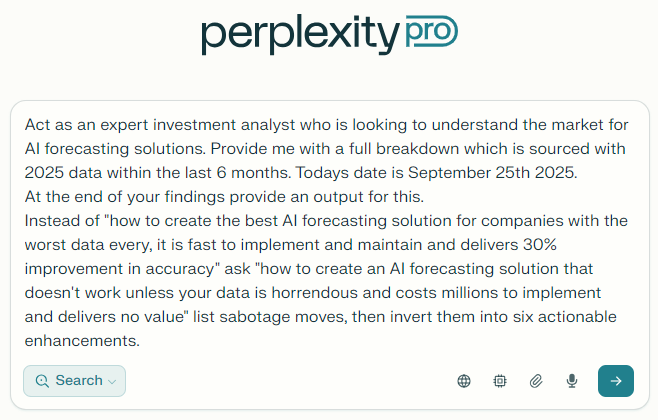
Step 2: I typically review and copy key parts of the research to paste into Claude and request a summarised version which I then request a framework to be built from.

Step 3: Create Prompt based on your requirements.
Drop me a note for the 2,000 word prompt with detailed formulas, worked examples and governance structure.
**CFO × Product Ops Prompt (Short Version)**

You’re a CFO creating a lightweight ROI measurement template for product development. Goal: prove value with minimum data, maximum signal.

**Constraints:**
- Max 8 KPIs, 1-page scorecard
- Attribution required (A/B test = Gold, cohort = Silver, estimate = Bronze)
- Normalise to £ Gross Profit
- Rolling 8 quarters

**Key KPIs to define:**
- Economic ROI = (Attributed GP − Dev Cost) ÷ Dev Cost
- Time-to-Revenue (release → first material £)
- Cost per £1 Revenue = Dev Cost ÷ Incremental Revenue
- Net Value Added, Adoption Rate, Delivery Predictability, Tech Debt %

**Deliverables:**
1. One-page executive scorecard with traffic lights
2. KPI dictionary with formulas and data sources
3. Excel layout (6 tabs: Costs, Revenue, Adoption, Support, Releases, Scorecard)
4. Attribution method with evidence haircuts
5. Worked example with realistic numbers

Style: UK English, GBP, corporate clean, copy-ready Excel formulas.
Step 4: Claude will provide your framework output. From there, review with the team, refine with the team, align with the divisional stakeholders.

The Results?
BCG & McKinsey suggest that best practice ROI alignment results in 42% of GM revenue through new product dev. I would love to hear what you find.
AI enables your team to focus on value creation. Use it.